
A few years ago, I dropped a pen on the floor and thought nothing of it.Then I bent down to pick it up.That’s when I noticed something had changed.My back felt tighter than I remembered. My hips seemed less cooperative. Standing back up wasn’t difficult, but it definitely wasn’t as effortless as it had been years earlier.
It wasn’t a major problem.It was just one of those small moments that makes you realize your body is asking for a little more attention.Like many adults over 50, I assumed stiffness was simply part of getting older. But after talking with active friends and experimenting with different routines, I learned something important:
A lot of that stiffness wasn’t coming from age alone.
It was coming from lack of movement.
That’s when I started adding a few gentle stretches into my daily routine.
Nothing extreme.
No advanced yoga poses.
No painful stretching sessions.
Just simple movements that helped my body feel more comfortable.The results surprised me.Getting out of bed felt easier. Walking felt smoother. Even sitting for long periods became less uncomfortable.If you’ve been feeling stiff lately, these gentle stretches may help you too.
Why Flexibility Matters After 50
Many people focus on strength and cardio, but flexibility often gets ignored.
The problem is that flexibility affects everyday activities more than most people realize.
Simple tasks like:
- Reaching overhead
- Looking over your shoulder while driving
- Getting out of a chair
- Climbing stairs
- Putting on shoes
- Walking comfortably
All require a healthy range of motion.
When flexibility decreases, everyday movements can feel harder than they should.The good news is that gentle stretching can help maintain and improve flexibility at almost any age.
The Biggest Stretching Mistake I Made
When I first decided to improve flexibility, I stretched far too aggressively.
I believed that if a stretch wasn’t uncomfortable, it wasn’t working.
That mindset quickly backfired.
Instead of feeling better, I felt sore and discouraged.
Eventually I learned that stretching should feel gentle.
A mild stretching sensation is fine.
Pain is not.
Once I started moving more patiently, my flexibility improved much faster.
How Often Should You Stretch?
Consistency matters more than duration.
Ten minutes of stretching most days usually works better than a long session once a week.
I personally aim for:
- 5–10 minutes daily
- Gentle movement before stretching
- Slow breathing throughout each stretch
Keeping the routine simple makes it easier to maintain.
Stretch 1: Neck Stretch
Many of us spend hours looking at phones, computers, and televisions.
The neck often becomes stiff without us noticing.
How to do it
- Sit or stand comfortably.
- Slowly tilt your head toward one shoulder.
- Hold for 15–20 seconds.
- Return to center.
- Repeat on the opposite side.
Avoid pulling on your head.
Let gravity do the work.
Stretch 2: Shoulder Stretch
This stretch helps relieve upper-body tightness.
Steps
- Bring one arm across your chest.
- Use the opposite hand to support it.
- Hold gently for 20 seconds.
- Switch sides.
This became one of my favorite stretches after long periods at a desk.
Stretch 3: Chest Opener
Poor posture often causes the chest muscles to tighten.
How to do it
- Stand tall.
- Clasp your hands behind your back.
- Lift your chest gently.
- Hold for 15–20 seconds.
This stretch feels especially good after sitting.
Stretch 4: Seated Torso Twist
The spine benefits from gentle rotation.
Steps
- Sit upright in a chair.
- Place one hand on the opposite knee.
- Rotate slowly.
- Hold briefly.
- Repeat on the other side.
Move comfortably without forcing the twist.
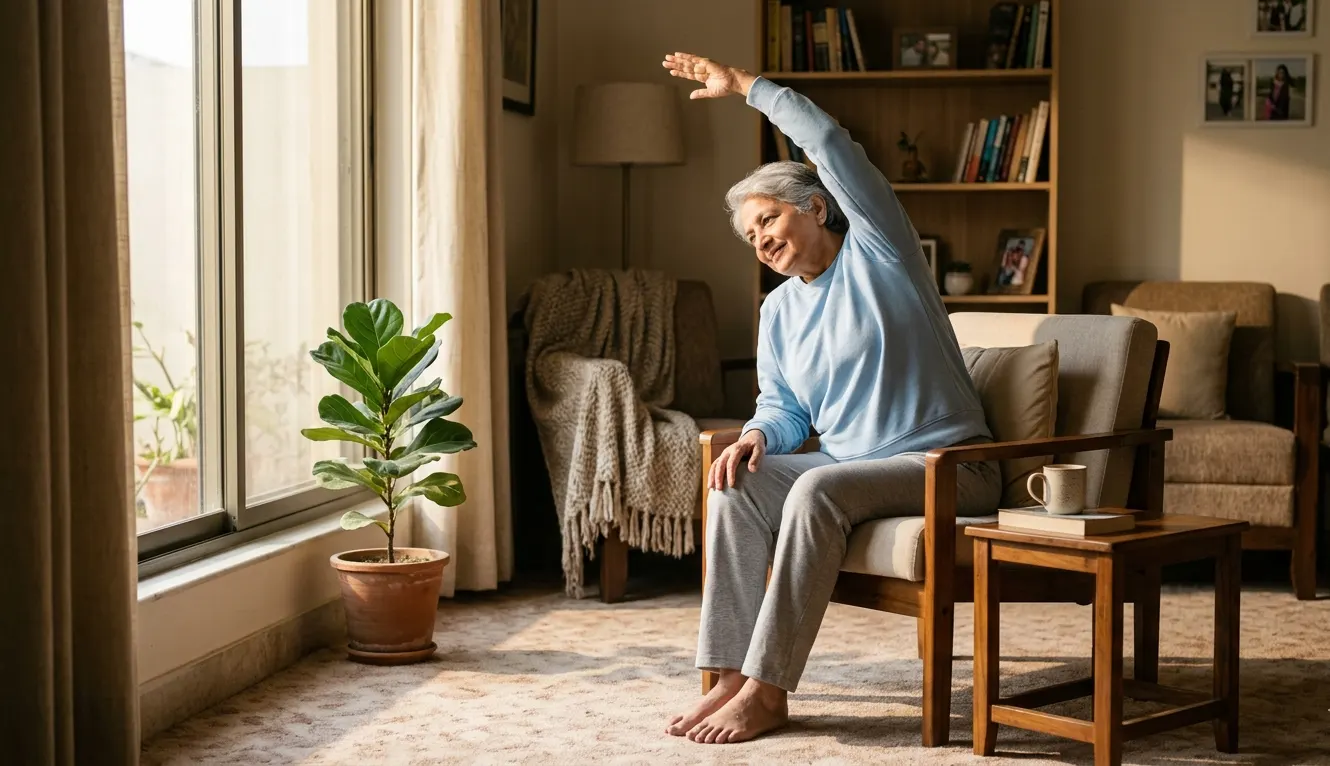
Stretch 5: Side Reach Stretch
This stretch targets the sides of the body.
Steps
- Stand comfortably.
- Raise one arm overhead.
- Lean gently to the opposite side.
- Hold for 15–20 seconds.
- Switch sides.
I often notice immediate relief from this movement.
Stretch 6: Seated Hamstring Stretch
Tight hamstrings can affect posture and movement.
Steps
- Sit near the edge of a chair.
- Extend one leg forward.
- Keep your back straight.
- Lean forward slightly.
Hold for 20–30 seconds.
Repeat on the other leg.
Stretch 7: Figure-Four Hip Stretch
This stretch helps improve hip flexibility.
Steps
- Sit comfortably in a chair.
- Place one ankle over the opposite knee.
- Sit tall.
- Lean forward slightly.
Hold for 20–30 seconds.
Switch sides.
Stretch 8: Calf Stretch
Healthy calves support walking and balance.
Steps
- Stand facing a wall.
- Place one foot behind you.
- Keep the heel down.
- Lean forward slightly.
Hold for 20–30 seconds.
Repeat on the other side.
Stretch 9: Ankle Mobility Stretch
Flexible ankles help maintain balance.
Steps
- Sit comfortably.
- Rotate your ankles slowly.
- Complete several circles.
- Reverse direction.
Repeat on both sides.
Stretch 10: Gentle Full-Body Reach
This is my favorite stretch to finish with.
Steps
- Stand tall.
- Reach both arms overhead.
- Stretch upward gently.
- Take several deep breaths.
Simple but surprisingly effective.
My 10-Minute Daily Flexibility Routine
When time is limited, this is the routine I use:
Minute 1
Neck stretch
Minute 2
Shoulder stretch
Minute 3
Chest opener
Minute 4
Torso twist
Minute 5
Side reach stretch
Minute 6
Hamstring stretch
Minute 7
Figure-four stretch
Minute 8
Calf stretch
Minute 9
Ankle mobility work
Minute 10
Full-body reach
It’s simple enough to do consistently, which is exactly why it works.
Helpful Tools for Stretching
You don’t need much equipment, but a few items can help.
Yoga Mat
Provides a comfortable surface.
Sturdy Chair
Useful for seated stretches.
Phone Timer
Helps avoid watching the clock.
Stretching Apps
Apps such as stretching and mobility trackers can help maintain consistency.
Common Stretching Mistakes to Avoid
Bouncing During Stretches
Stretch slowly and steadily.
Holding Your Breath
Relaxed breathing helps muscles release tension.
Stretching Through Pain
Pain is a signal to stop or reduce intensity.
Being Inconsistent
Flexibility improves gradually through regular practice.
Comparing Yourself to Others
Focus on your own progress.
Everyone’s body moves differently.
What Changes Can You Expect?
Most people don’t suddenly become dramatically more flexible.
Instead, improvements often appear in everyday life.
You may notice:
- Easier movement
- Less morning stiffness
- Better posture
- Improved mobility
- Greater comfort while walking
- More confidence during daily activities
These small changes can make a surprisingly big difference.
Final Thoughts
Improving flexibility after 50 doesn’t require complicated routines or advanced stretching techniques.A few minutes of gentle stretching each day can help your body feel more comfortable, mobile, and capable.
Start with one or two stretches if that’s all you have time for.
The goal isn’t perfection.
The goal is moving a little better today than you did yesterday.
Over time, those small improvements add up into something meaningful.